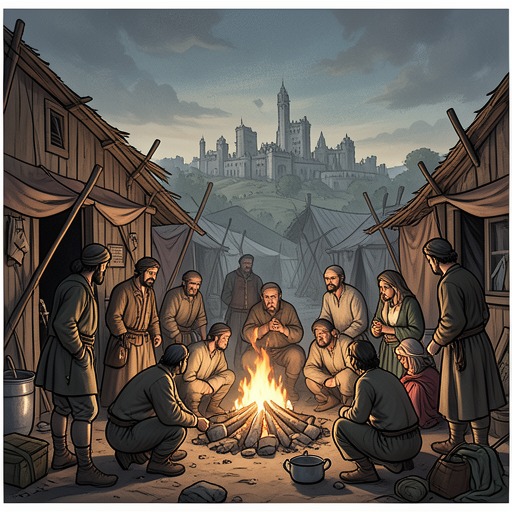
New Petoskey
Station ElevenNew Petoskey is a post-collapse town where printed news gives a largely local world a way to imagine beyond itself. Its librarian, François Diallo, also publishes and edits the New Petoskey News, an irregular newspaper that records everyday exchange while carrying literature and testimony. Through the paper and Diallo’s interview with Kirsten Raymonde, the town becomes both a center of community information and a point of contact with the vanished pre-collapse world.
A Local Center in a Shrunken World
By Year Fifteen, most people rarely left their towns. Diallo describes the world as having become local: traders brought stories from elsewhere, but travelers who could report on other places were unusual. In this setting, New Petoskey’s newspaper does more than announce events within town. It gives residents accounts of lives and journeys beyond their usual reach, making news from elsewhere a form of connection as well as information.
Diallo had been the town’s librarian since Year Four. He had recently started the newspaper and interviewed people passing through, asking Kirsten Raymonde to talk about the towns she had visited with the Travelling Symphony. His interest reflects the practical limits of movement after the collapse: a visitor’s experience can matter to readers who are unlikely to see those places themselves. The town’s role as a gathering point for news depends not on a surviving communications network, but on people arriving, speaking, and carrying information onward.
The New Petoskey News
In the fall of Year Fifteen, a trader who had been visiting the airport since Year Six brought Clark three sheets of rough paper for his museum. The sheets were three consecutive issues of the New Petoskey News, though several months out of date. Published irregularly, they made a durable record of events and needs that had once been conveyed through faster electronic channels.
The notices were strikingly specific. The paper reported births, deaths, and weddings; a local man offered milk and eggs in exchange for new shoes, while another resident sought jeans in size 6 for a pair of reading glasses. It warned readers about three ferals—a woman and two children—sighted southwest of town, advising them to avoid the group and, if contact happened accidentally, to speak gently and make no sudden movements. These details place ordinary exchange and immediate safety side by side. The newspaper does not present recovery as an abstract process: it records what people need, whom they have lost, and what dangers they may encounter nearby.
The issues also reported that the Travelling Symphony had passed through town. A rapturous review of its performance of King Lear singled out Gil Harris as Lear and Kirsten Raymonde as Cordelia. Elsewhere, a local girl offered a litter of kittens, noting that their mother was a good mouser, and the library reminded readers that it accepted books in exchange for wine. The combination of performance, barter, domestic news, and literary exchange shows a paper attentive to both survival and culture. Its information is local in scale, but its range gives the community a shared account of its own activity.
Library, Literature, and Testimony
Diallo filled empty space in the newspaper with writing from his library collection. The first issue included an Emily Dickinson poem; the second, an excerpt from a biography of Abraham Lincoln. In a slow news month, the entire back of the third issue went to an interview with Kirsten. This editorial practice makes the paper a meeting place for different kinds of record: announcements about present-day needs, accounts of recent visitors, and texts preserved from the past.
The interview also gives New Petoskey a connection to Arthur Leander. Diallo had not encountered Kirsten’s space-station comics or other works in the series when she showed them to him. She told him that Arthur had given them to her, identifying him as the actor she had discussed. The exchange establishes the comics as objects carried into the post-collapse world and preserves their personal history through Kirsten’s account. The newspaper does not merely reproduce public events; it can also hold a small piece of evidence about a relationship and a life otherwise separated from its readers by time and the collapse.
Kirsten’s interview is especially consequential to Clark, who reads it in the airport. Her account of Arthur’s death onstage makes him stop breathing for a moment: the printed words bring him into contact with someone who knew Arthur and witnessed his death. New Petoskey itself is not the scene of that earlier event, but its newspaper carries the testimony across distance. A local publication thus becomes part of how people elsewhere encounter and remember the dead.
Paper After the Network
The newspaper’s significance is sharpened by the disappearance of electronic communication. During the collapse, the Internet blinked out after the remaining television channels had dwindled to static, test patterns, and repeated emergency broadcasts. Later, children at the airport learned about the Internet as a system that had once connected people and transcended borders; even teenagers struggled to grasp the borders it had crossed. Against that history, New Petoskey’s rough, delayed issues offer a markedly different kind of connection: limited in circulation and irregular in arrival, but tangible and readable.
That contrast does not make print an equivalent replacement for the old network. A few sheets arrive months late, carried by a trader whose usual specialties are cookware, socks, and sewing supplies. Yet the paper can be saved, read, and placed in a museum; its contents remain available after the moment of delivery. It binds readers through concrete, shared knowledge rather than an invisible, worldwide flow of updates. New Petoskey’s newspaper therefore embodies both the loss and the persistence of communication: the global network is gone, but news, literature, memory, and curiosity still travel by hand.